

Downtown Parking Management Updates
The City of Fort Collins is proposing updates to the downtown parking system to make it financially sustainable, fair and easier to use.
This webpage is the official source of information from the City of Fort Collins about updates to the downtown parking system, along with other official City of Fort Collins communications channels.
Current Parking System Model
Today, downtown Fort Collins has an “upside down” system:
- The closest street parking is free with a 2-hour limit.
- Nearby City-owned garages cost $1 per hour, with the first hour free.
- With ongoing maintenance requirements, the three City garages operate at a financial loss.
This creates an imbalance. The most convenient spaces — directly in front of businesses — are free, while garages a short walk away require payment. Naturally, as a result of that upside down model, the on-street parking availability becomes overcrowded with users wanting to park close to their destination, and the paid parking revenue doesn't cover the cost of maintaining and operating the parking system as a whole.
As downtown continues to grow, this model isn't financially sustainable. It also limits turnover in high-demand areas, making it harder for customers to find convenient parking.
How Free Parking Works and How We Fund It
Free parking is never truly free — the cost is simply paid in less visible ways. When parking is offered at no charge, someone still pays to build it, maintain it and manage it. Those costs are often absorbed into local tax structures (higher rents, higher prices for goods and services), public subsidies or deferred maintenance.
A fully “free” model shifts costs broadly across the community. A user-paid model aligns costs more directly with usage and can reduce pressure on general tax revenues.
Fort Collins currently operates with free on-street parking and a user-paid model in its parking garages, charging only those who use garage parking. But due to the “upside down” model of the paid parking system, parking revenue from the City’s parking garages isn’t fully funding the City’s parking system.
Based on feedback from the community as well as the City’s consultants, the City is recommending a variety of changes to its parking system, including implementing paid on-street parking.
What’s Changing: Near-Team
Anticipated near-term changes include:
Beginning March 23, 2026: Moving to six day per week, 8 a.m.-6 p.m. enforcement of on-street parking.
Beginning Sept. 1, 2026, pending City Manager's approval: Increasing fines for parking violations
Beginning Sept. 1, 2026, pending City Manager's approval: Removing the City’s current “Courtesy Notice” for first-time violations, implementing a fine
Increasing options for downtown parking permits, including employee parking permits for employees of downtown businesses
Installing better parking enforcement mechanisms in the City’s parking garages
A managed parking system is essential to supporting a thriving downtown. The City is working with all stakeholders in downtown Fort Collins to ensure the solutions implemented are the best possible solutions for everyone.
What’s Changing: Long-Term
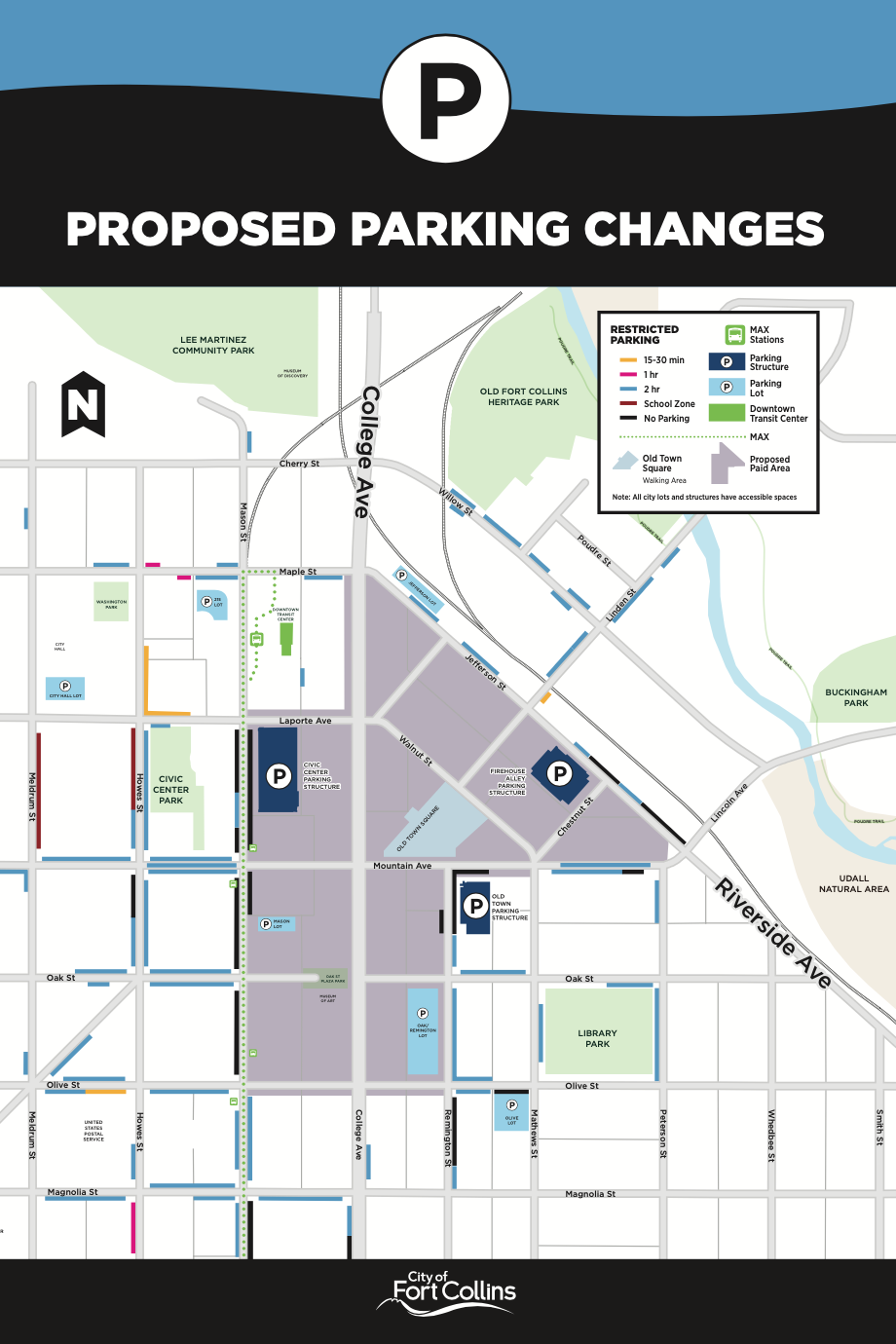
A map of the City’s proposed updates to downtown parking, including a new proposed paid parking zone shown in purple. All parking, including street, lot and garage parking, inside the purple zone would have an associated fee.
More specific details about the City’s proposed parking updates will be provided following additional meetings with City Council. Any expansion of paid parking downtown as a part of these updates is expected to be implemented in 2027 or 2028.
What We Heard From the Community
Since October 2025, the City has hosted Open House events, public engagement tables in Old Town Square, focused engagement events with downtown businesses and stakeholders, and online engagement on this webpage.
Common themes we heard:
Concern about impacts to small businesses
Concern about employee parking
Questions about enforcement practices
Questions about financial transparency
Interest in fair pricing and turnover
Concern about long-term infrastructure costs
The final recommendation reflects this feedback, including updates to enforcement practices, technology improvements and financial transparency.
FAQs
We've answered our most frequently asked questions (FAQs) from the community in the Project Updates section below (see: FAQs) with detailed feedback.

-
 2006 Downtown Strategic Plan (50.7 MB) (pdf)
-
2013 Parking Plan (10.4 MB) (pdf)
-
2014 TOD Parking Study (6.02 MB) (pdf)
-
2017 Downtown Plan (28.7 MB) (pdf)
-
2025 DRAFT Parking Study Implementation Action plan (5.22 MB) (pdf)
-
2026 Fort Collins Pro Forma Analysis (4.09 MB) (pdf)
-
2026 City of Fort Collins Downtown Parking Study DRAFT.pdf (27.1 MB) (pdf)