
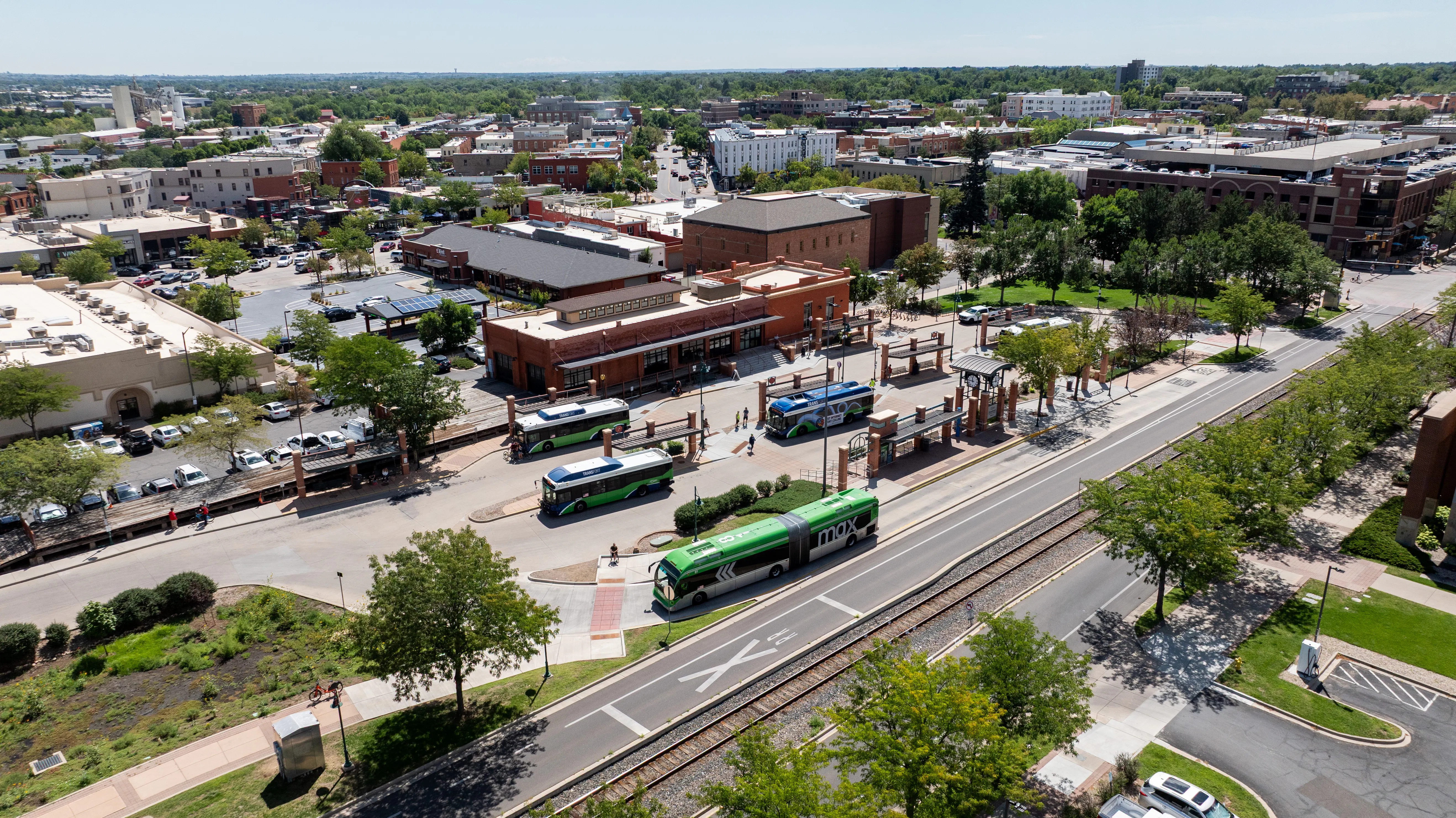
Transfort Optimization Plan
The Transfort Optimization Plan (Phase 1) was developed through community feedback, data analysis and transit industry best practices providing the community with more frequent service on key routes and a simpler, grid-based network. The changes were designed to improve frequency, reliability and connections while operating within available resources. Phase 1 changes were implemented on August 17, 2026.
The Dial-A-Ride service area changed to match the updated fixed-route bus system. Dial-A-Ride service hours are 6 a.m. - 9:30 p.m. Dial-A-Ride service no longer operates on Sundays. Dial-A-Taxi vouchers have a value of $15 each and the Dial-A-Taxi service area expanded toContinue reading
Submit a comment
City of Fort Collins,
As a member of the community who greatly appreciates this service and has used it for over a year now to travel to different areas of the city, I was highly skeptical of the new changes being made to the bus routes, seeing as it would eliminate the main route I take every day. But, in the spirit of progress, I decided to try the new system, excited that the bus routes would be more frequent and optimized as the project detailed.
Giving it a two-week trial period, however, I feel that this plan has greatly impacted my daily commute times and has left me frustrated. Eliminating the route 2 and 31 bus loop to campus has doubled my personal travel time from 20 minutes a day to over 40 minutes a day one way. This is because I now need to complete a 15-minute walk to the bus stop to access the system, whereas before, I had a 5-minute walk to access the service.
Furthermore, the plan touts that the main routes will have more frequent service. While I have found that to be true during some times (earlier in the day), other times of the day – main times for students and other travelers (example 3pm onward), is pushed to 20 minutes between services. When the route traveled is heavily relied on by students, such as mine, the buses are often at capacity, forcing people to wait for the next service. This has made the system unreliable for myself, where I rely on the bus to get me to and from areas of Fort Collins in a timely manner.
Finally, I have found that the ten-minute frequencies between bus services - when the buses are expected to arrive at the main stops along the route – are not reliable either. I have experienced buses arriving significantly past their scheduled time (7-12 minutes) several times during the 2-week period I have used this new service. While I understand it takes a while for new bus drivers to get used to their routes, and for traffic to effect bus times, this feels the very opposite of the goals laid out in the plan.
I would ask at the very least to restore the route 2 bus loop, adding a stop to CSU campus – which was a very popular student relied upon route, or add additional services for heavily populated times along route 3 so that all passengers are able to reliably take the bus at their desired times.
Restoring the bus 2 loop would help to alleviate some of the pressure on the packed route 3 and would even help to create a more frequent bus service if two routes serviced similar areas. Or adding a stop to the CSU campus for route 2 helps students who rely on that route to commute to campus in a timely manner and takes some pressure off the packed route 3.
Thank you for continuing to listen to community feedback as you navigate how to best serve the community through this bus service.
Please add a city bust stop near vine drive and emmerson
When will the system include broader areas? None of the plans include the corner of S. Overland and Drake. Or Timberline and Horsetooth.
Will you consider extending the half-hour frequency of stops on Route 19-Northbound to begin at approximately 8:30 a.m., rather than 9:30? The Larkborough neighborhood north of Harmony and east of Shields recently learned that school bus service will no longer be provided to those kids going to Rocky Mountain High School. Extending the times to the half-hour would allow for students to ride Transfort to Rocky and arrive shortly before the school day begins.
I am very sad the 32 bus line is going to be eliminated. It is one of the only buses that goes by rams village at night. I work later in the evenings and nights and the bus the only transportation I can afford or use right now. There’s no other buses that go to rams village besides the 31 and 3 but they stop around 5pm. Please find a way to make a route to go to rams village up until 10 pm. People need to get home from work and people who rely on the bus are really struggling with the cuts
Also there are no direct routes to the harmony transfer centre besides the 19 or max and then the 16 but they run once an hour and they are not frequent enough. People get dropped off at harmony and are stuck with no way to get home or waiting for an hour in the cold or rain.
I understand the need to realign routes with demand, but am nonetheless disappointed to lose all 3 stops on Vine (between I-25 Frontage Road to Timberline) on route 14. This removes access for multiple neighborhoods east of Timberline to reach the Downtown Transit Center, and is well over a mile to the nearest stop for Waterglen residents.
Many students rely on route 2 to get to campus as a reliable and consistent means of transport to the campus specifically to the transit center. The newly proposed guarantees neither of these. This proposition does not reflect the community wants.
The proposed routes will leave future current and future CSU students living on Prospect Rd. without a direct route to CTC. As of now, the 2 & 32 lines connect the residential areas on Prospect to CSU, specifically the CTC. The current routes of 2 & 32 have high demand given that 2 bus routes run along Prospect much like how routes 3, 31,& 32 support Elizabeth & Constitution. The new route shows that the 2 line will no longer stop at CTC as well as removal of the 32 line. A possible solution would be to extend the new route 2 line to the CTC.
The proposed maps leave the CSU students living on prospect without a direct route to CSU. Currently the 32 and the 2 routes connect residential areas on prospect with CSU. Both the 32 and 2 have high demand from CSU students given that they run two buses for the 32 route in the mornings to keep up The new map shows that the route 2 no longer stops at the CSU transit center and the 32 is no longer there. If the route 32 must be removed, all of the CSU students along prospect would benefit from the 2 stopping at the CSU transit center. Please reconsider the changes along Prospect.
As a student who has taken the 32 from Prospect and Heatheridge to campus every morning the past year (and the 2 home from CSU every afternoon), this plan is extremely disappointing and frankly does not increase rider accessibility. I have relied on Transfort for an easy way to campus every morning and now will have to consider an expensive CSU parking pass. Please reconsider implementing a route on Prospect direct to the CSU transit center. I would rather pay for a bus pass than try to find parking or pay for a parking pass on CSU’s campus. Most major cities do charge to maintain revenue, and I don’t understand why the City of Fort Collins hasn’t reimplemented paid bussing and instead slashes routes regularly.
Eliminating the 32 and diverting the 2 from the transit center will make my commute much more difficult. Maintaining at least 1 route that serves prospect to the transit center would make my commute much more manageable this fall.
Please don't remove route 6. I use it multiple times a day all week to travel to and from CSU for class, and my only alt is a bike.
Cutting the 6 route will leave Northern FoCo neighbors without a local bus service. The 7 was already cut, leaving me one with one bus per hour to catch at the Mullbery stop. This encourages everyone in my neighborhood to drive rather than use a local bus system.
Being able to get from the DTC to the CTC without needing to cross over active railroad tracks seems only common sense, especially for disabled riders. Not having a bus directly connecting the transit centers seems ridiculous, as does having no way for early morning commuters to get on the Flex line/ no Flex from the DTC. There ought to be a way for someone to be able to commute from downtown Ft Collins to downtown Boulder to get to work for a morning shift.
Obviously Taft Hill needs service. More frequent service overall would be a benefit, (excepting the 3/31 routes, which I saw have literally 4 buses backed up eastbound on 3/2/26).
It seems much of the community supports at least revisiting modest fees, especially if it means more flexibility to provide sufficient service where it currently may be lacking.
Additionally, many communities use and design public transport to provide bus service for middle- and high-school students. It would seem this could be explored and factored into map design, as it could seemingly benefit the school district and the overall community.
Hi there, I have lived next to one of the 32 route bus stops for 5+ years, and believe it is imperitive to keep that route in service as-is. Some key reasons I believe such:
-Students. The 32 runs past multiple apartment complexes and renter neighborhoods, many of which are housing to students, and the 32 provides transit for them directly to CSU and to a major grocery store.
-Accessability. As a frequent user of the 32 and someone with a spinal injury myself, I can attest that multiple folks with visible disabilities (whether that's via wheelchair, prosthetics, or service dogs) regularly ride the 32, and I'm sure many more with invisible disabilities. The route serves a way for those of us with accessibility concerns and elders to easily reach both the university and a grocery store.
-Parking. Colorado State University is notoriously short on parking, and students need to pay hundreds of dollars each semester to park in only some lots which are already oversold. Many smaller neighborhoods are also having issues with street side parking availability, and removing such a key bus line will only increase the number of especially students who need to get cars to efficiently and easily get to class on time.
-Weather hazards. When visibility is low via fog, rain, wind and dust, snow, or the roads are icy and dangerous to drive on, the bus provides a surefire safe way to not only get students to class on time, but to keep more cars off the roads and prevent more access. I've been on the 32 many times in winter where even with 2 busses running together it's standing room only.
-Late night safety. Many young students, especially young women like myself, feel very unsafe walking alone at night. As a side effect of the time of year classes run, going home once it starts getting dark is inevitable, and for those of us who either don't want, cannot afford, or perhaps are temporarily out of a car, having the 32 straight from the university is very reassuring. I've been followed home while walking 4 seperate times in 5 years, and even with lights on my bike I was run over and my bike destroyed while crossing a crosswalk at 4:30 pm in December by a truck that just could not see me with how dark it was.
Overall, none of the presented project plans include maintaining the 32 and I believe that would be a mistake if the goal is to encourage more usage of the transit systems. Regardless of the plan used, the 32 should remain running, as taking two separate busses via some new fourth transit center just isn't feasible for many of us who simply want to get directly to class in 30 minute increments, or run to the grocery store and be back within an hour
Thank you for your time,
Kyla Carpenter
I want to make sure that the bus stops on Overland Trail road between Elizabeth and Prospect will continue to be utilized now that it looks like route 2 has been changed to an out and back instead of a loop. We have students who rely on this route and the disconnect to Campus West requiring a bus change at Overland Trail/Elizabeth is unfortunate for route 2. The accessibility upgrades to the Overland bus stops were a great improvement so I want to make sure this area continues to be utilized by public transit, especially considering the upcoming development of the Hughes property. Also having the 2 or the 3 routes directly connect with a Max bus stop are a must have.
Please consider bringing back the route on the south end of town. There are many families along Trilby that would love to be able to ride the bus into to town.
The most recently proposed optimization plan does not fully encapsulate the needs of Fort Collins residents and the values of the City of Fort Collins. Particularly, the removal of route 6 and route 10 leaves major spatial gaps for residents near/on Taft Hill as well as Mulberry. While it is understandable that priorities must be made based on budget constraints and ridership data, the removal of these routes directly opposes the City of Fort Collins's values of service and sustainability. Fort Collins strives heavily to be a community-oriented municipality while entirely removing major routes that serve heavily residential areas. Removal of routes in these areas then forces residents to find alternative means of transportation, which includes but is not limited to personal vehicles that many people do not have access to.
Route 6 has been claimed to be removed due to low ridership data, but it is unclear if that data been evaluated beyond that statistic. Is it low ridership overall? Or is that data directly in comparison to routes which serve primarily CSU/Downtown Transit Routes? Routes that serve in/around CSU and downtown are likely going to have higher ridership as routes are very frequent due to their condensed spatial nature, allowing commuters to save a 10+ minute commute. Routes that are further away from these centers are going to have lower ridership but should be deemed as higher priorities as they are potentially saving commuters a 60+ minute commute with no other viable options being available.
Several government organizations on the Front Range are facing budgetary restraints, and it is disheartening that Fort Collins is considering negatively impacting its residents as a result and violating its core values. Greeley-Evans transit is continuing to work on major upgrades to its transportation mobility planning efforts to expand public transit, and Fort Collins can ideally take some lessons from its Front Range neighbor.
I urge the City of Fort Collins to significantly reconsider the approach the proposed optimization plan and the removal(s) of route 6 and 10. Alternative approaches could include stops and/or frequency reductions, but the removal of major roadway routes is a poor decision that should be reconsidered.
I am a grad student at CSU who relies on the bus to get to campus. I use the 32 line daily to get to school. Taking this away would greatly impact the times I get to campus. If taking away the 32 bus is necessary can there be more frequent times on other lines like the 2?
The new optimization plan does not include bus route 6. I rely on this route to get to work, and without it, would need to pay out of pocket for other transportation/parking options. Mulberry and Taft Hill are two major roads, and removing the 6 route leaves these two busy areas of town completely without service. I urge you to include the 6 route.
-
 Final Optimization Plan.pdf (24.3 MB) (pdf)
-
City Council Work Session Presentation - March 24 2026.pdf (713 KB) (pdf)
-
City Council Work Session Agenda Item Summary - March 24 2026.pdf (721 KB) (pdf)
-
Transfort Optimization Plan - Scenario Development Details.pdf (2.36 MB) (pdf)
-
Presentation to City Council - Oct. 28 2025.pdf (2.84 MB) (pdf)

Thank you for your contribution!
Help us reach out to more people in the community
Share this with family and friends